Wednesday, July 18, 2012


Tuesday, July 10, 2012
The Greening of Florida Citrus

Many of us will recall the Citrus Canker eradication program begun in January 2000 when the state Dept. of Agriculture adopted a policy of removing all infected trees and all citrus trees within a 1,900 foot radius of an infected tree in both residential areas and commercial groves. By 2006, the program was suspended after the U.S. Dept. of Agriculture declared that eradication was not practical.
Tuesday, July 3, 2012
Lions, and Tigers, and Bears! Oh My!

It’s unlikely that you’ll meet up with any of these creatures in your backyard, but because of its great diversity of habitat types, Florida is home to more wildlife species than most other states. So you may find some less exotic animals on your property creating a nuisance and understanding why they are there is key to resolving the problem.
Snakes
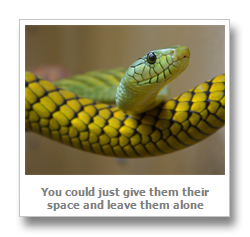
Snakes are actually beneficial to the environment. They eat insects, rats, mice, worms, toads, frogs, fish and some snakes even eat other snakes, including the venomous ones. You could just give them their space and leave them alone. They’re not aggressive and don’t chase after people. But if snakes are a problem for you, IFAS says their visits to your yard and home can be reduced by eliminating firewood stacks, debris, boards and other objects lying close to the ground. These create the cool, damp and dark shelter or prey habitat areas that snakes prefer.
There are no repellents, poisons or fumigants registered for snakes. They can be removed from inside buildings with the use of a glueboard or funneled minnow trap. Glueboards are sold at hardware stores while minnow traps are available at bait and tackle shops. Finally, a broom can also be used to sweep a snake into a trash can for removal outside.
Armadillos

Monday, June 11, 2012
Poisonous Plants
She comes on like a rose but everybody knows
She'll get you in Dutch
You can look but you better not touch
Poison iv-y-y-y-y, poison iv-y-y-y-y
Late at night while you're sleepin' poison ivy comes a'creepin'
Arou-ou-ou-ou-ou-ound
The Coasters, Poison Ivy (Leiber & Stoller, 1959)
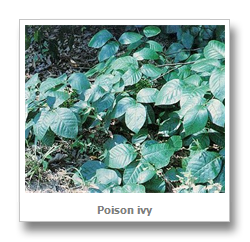
The 1950’s were a more innocent time than today. In their 1959 hit Poison Ivy, The Coasters weren’t singing about poison ivy, the plant, but about another kind of poison, which wasn’t discussed much in public then. Today, however, we’ll stick with the plant and other plants used for beautification in and around Florida homes that are irritating if they come in contact with the skin, like poison ivy, and others that are toxic if eaten.
Poison Ivy
Wednesday, May 23, 2012
Mighty Mite Is On Its Way to a Palm Near You

Sucks the Life Out
Bright red with a long, spatulate body, this “mighty mite” is known to feed and reproduce on at least 32 palm species, bananas, gingers and heliconias. This pest lives for about 26 days. It thrives on the underside of leaves and fronds and in high numbers causes yellowing of the leaves followed by death of plant tissue. They stick their sucking snouts into the stomata of leaves and feed directly from deep within the leaf. This causes mechanical damage to the stomata so that they are no longer able to close and the leaf dries out.
Wednesday, May 9, 2012
Mosquitoes Are Itching To Get You
Contrary to popular belief, neither Lemon Fresh Joy® nor Listerine® will keep mosquitos from bothering you. Neither will used dryer sheets stuffed in your pockets. In addition, there is no scientific evidence that eating garlic, vitamins, onions or any other food will make a person repellent to mosquitoes, or that wearing devices that emit sound will repeal mosquitoes. Keep reading to find out what does work.
For the Female Is More Deadly Than the Male
As adults, both male and female mosquitoes feed on sugars from plants and other insects that feed on plant sugars. This is the only source of nutrition for males; they do not feed on blood. The females use the sugar meals for energy and the blood meals for egg development. She doesn’t actually bite but stabs by piercing her proboscis, which is a tubular appendage, and drinks between 0.0001 and 0.01 milliliters. She’ll continue to bite and draw blood until her abdomen is full. If she’s interrupted before she’s finished, she’ll fly on to the next person. The bumps and itch left on your skin after a mosquito has bitten you are an allergic reaction to mosquito saliva. The reaction can vary from person to person, but usually lasts no more than 24 hours.
Friday, April 27, 2012
Real Bats Eat Bugs
Vampire bats latch on to people and suck their blood. Fact or fiction? Definitely not true. Unlike our friend above, Count Dracula, vampire bats do not latch on and suck blood, nor do they turn animals –
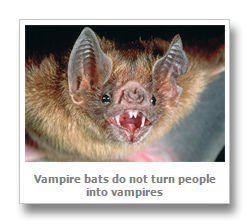
There are 900-1,000 species of bats classified in about 200 genera and 17 families. They range in size from a wingspread of over 5 ft. to less than 2 in. Bats are the only mammals that can fly. The wing is actually a double membrane of skin stretched between the elongated bones of four fingers and extending along the body from the forelimbs to the hind limbs and from there to the tail.