Monday, June 11, 2012

Poisonous Plants

She comes on like a rose but everybody knows
She'll get you in Dutch
You can look but you better not touch

Poison iv-y-y-y-y, poison iv-y-y-y-y
Late at night while you're sleepin' poison ivy comes a'creepin'
Arou-ou-ou-ou-ou-ound

The Coasters, Poison Ivy (Leiber & Stoller, 1959)

  Internet Archive

The 1950’s were a more innocent time than today. In their 1959 hit Poison Ivy, The Coasters weren’t singing about poison ivy, the plant, but about another kind of poison, which wasn’t discussed much in public then. Today, however, we’ll stick with the plant and other plants used for beautification in and around Florida homes that are irritating if they come in contact with the skin, like poison ivy, and others that are toxic if eaten.

Poison Ivy
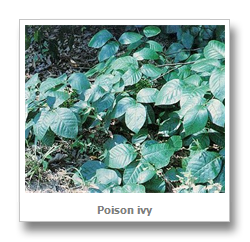
Poison ivy grows throughout most of North America, and is normally found in wooded areas. The plant is extremely common in suburban and exurban areas of New England, the Mid-Atlantic, and southeastern United States. It is not particularly sensitive to soil moisture, although it does not grow in desert or arid conditions. It grows in a wide variety of soil types. Poison ivy is dioecious; flowering occurs from May to July. The yellowish- or greenish-white flowers are typically inconspicuous and are located in clusters up to 8 cm (3.1 in) above the leaves. The berry-like fruit, a drupe, is mature by August to November with a grayish-white color.

Wednesday, May 23, 2012

Mighty Mite Is On Its Way to a Palm Near You

After devastating coconut palm trees in the Caribbean, the red palm mite made its way to Palm Beach County almost five years ago when it was discovered in Palm Beach Gardens. Today, these critters are known from 386 sites in five Florida counties, which includes 154 sites alone in Palm Beach County. The invasion of this species is the largest mite explosion ever observed in the Americas.
Sucks the Life Out

Bright red with a long, spatulate body, this “mighty mite” is known to feed and reproduce on at least 32 palm species, bananas, gingers and heliconias. This pest lives for about 26 days. It thrives on the underside of leaves and fronds and in high numbers causes yellowing of the leaves followed by death of plant tissue. They stick their sucking snouts into the stomata of leaves and feed directly from deep within the leaf. This causes mechanical damage to the stomata so that they are no longer able to close and the leaf dries out.

Wednesday, May 9, 2012

Mosquitoes Are Itching To Get You

Contrary to popular belief, neither Lemon Fresh Joy® nor Listerine® will keep mosquitos from bothering you. Neither will used dryer sheets stuffed in your pockets. In addition, there is no scientific evidence that eating garlic, vitamins, onions or any other food will make a person repellent to mosquitoes, or that wearing devices that emit sound will repeal mosquitoes. Keep reading to find out what does work.

For the Female Is More Deadly Than the Male

As adults, both male and female mosquitoes feed on sugars from plants and other insects that feed on plant sugars. This is the only source of nutrition for males; they do not feed on blood. The females use the sugar meals for energy and the blood meals for egg development. She doesn’t actually bite but stabs by piercing her proboscis, which is a tubular appendage, and drinks between 0.0001 and 0.01 milliliters. She’ll continue to bite and draw blood until her abdomen is full. If she’s interrupted before she’s finished, she’ll fly on to the next person. The bumps and itch left on your skin after a mosquito has bitten you are an allergic reaction to mosquito saliva. The reaction can vary from person to person, but usually lasts no more than 24 hours.

Friday, April 27, 2012

Real Bats Eat Bugs

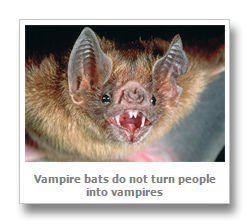
Vampire bats latch on to people and suck their blood. Fact or fiction? Definitely not true. Unlike our friend above, Count Dracula, vampire bats do not latch on and suck blood, nor do they turn animals –

or people – into vampires. Nor, according to the Centers for Disease Control and Prevention, do most bats have rabies. Bats are, in fact quite timid and usually ignore humans.

There are 900-1,000 species of bats classified in about 200 genera and 17 families. They range in size from a wingspread of over 5 ft. to less than 2 in. Bats are the only mammals that can fly. The wing is actually a double membrane of skin stretched between the elongated bones of four fingers and extending along the body from the forelimbs to the hind limbs and from there to the tail.

Thursday, April 19, 2012

What’s Behind Two Fleas?

A canine flea collar commercial currently running on television asks the question: What’s behind two fleas? Answer: The next generation. A female flea can lay hundreds of eggs on your pet, ensuring that its work will be carried on by generations to come.

One Flea 400 Bites

A single flea can bite your cat or dog more than 400 times. During the day, the flea can consume more than its body weight of your pet’s blood. While flea bites may be just a nuisance to some pets, they can be dangerous to others. They cause allergies and a pet’s constant scratching to rid itself of fleas can cause permanent hair loss and other skin problems. A pet can get a tapeworm if it eats a flea that has one. Fleas feasting on your pet’s blood can cause anemia and, in rare cases, death.

About 1/16th of an inch, fleas are dark, reddish-brown, wingless insects. Their bodies are flattened side to side, which allows them easy movement through your pet’s coat. Their bodies are hard, polished and covered with many hairs and short spines directed backward. Their long legs give them the ability to jump seven or eight inches into the air.

Sunday, April 8, 2012

Itsy Bitsy Spider Creepy and Crawly on the Kitchen Wally

De Spin/The Spider

Allow video to load, then click to play

The itsy bitsy spider went up the water spout
Down came the rain and washed the spider out
Out came the sun and dried up all the rain
And the itsy bitsy spider climbed up the spout again


The Tale of Little Miss Muffet
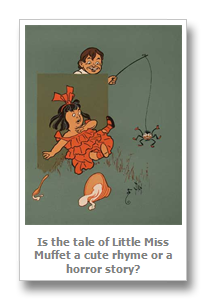
As if spiders didn’t frighten us enough as children when we heard how one chased Little Miss Muffet away as she tried to eat her curds and whey, our fear was heightened in 2001 with the grade B monster movie Arachnid in which a giant killer spider menaces the survivors of a plane crash. Fortunately for the survivors, the spider loses when it falls onto a stalagmite.

Spiders are arthropods called arachnids. There are some 34,000 species belonging to about 105 families, although some specialists in the study of arachnids estimate that only 20 percent of spider species have been described, which means that there may be as many as 170,000 spider species.

Monday, April 2, 2012

Not Even Mighty Mouse Can Save the Day If Your Home Is Home to Mice and Rats

Everyone over a certain age will remember Mighty Mouse. Beginning on television in 1955, and continuing for almost 12 years, Mr. Trouble never hung around when he heard this mighty sound. “Here I come to save the day! That means that Mighty Mouse is on the way.”

When rats and mice enter homes, farm buildings and warehouses, they’re not there to turn a “wrong to right.” They’re seeking food and shelter. They eat or contaminate large quantities of food and damage buildings, stored clothing and documents. They also serve as carriers of disease, including Rat-bite fever, Weil’s Disease, pox, plague, trichinosis, typhoid and a host of others.